EVO ICL lens implantation · Gangnam, Seoul
Sharp vision without glasses, from the surgeon who brought ICL to Korea.
BGSS Eye Clinic has specialised in Implantable Collamer Lens surgery since 2002. Our founder, Dr. Jong-Ho Lee, performed Korea's first ICL procedure, trains other surgeons as an EVO ICL Expert Instructor, and publishes peer-reviewed research on lens stability.
English · 中文 · 日本語 · Tiếng Việt · Монгол coordinators. Exam and both-eye surgery on the same day when your lens is in stock.
- 2026 APAC Regional Center of EVO ICL Training
- 2024 Outstanding Global Contribution to EVO ICL, first in Korea
- 2023 KSCRS Best Paper, V-Toric ICL
- 2023 APACRS Best Poster
- 2006 STAAR Surgical ICL Instructor
Experience you can measure
24 years and 66,000 lens implantations.
In ICL, outcomes depend on lens sizing, vault prediction and astigmatism alignment. Each of those improves with the number of eyes a team has measured and followed up. Our record began with Korea's first case.
- 2002 Dr. Jong-Ho Lee introduces ICL to Korea
- 2006 Appointed official STAAR Surgical ICL instructor
- 2013 Brings the central-port (Aqua) ICL to Korea
- 2017 EVO+ ICL and same-day both-eye surgery
- 2020 Develops the vertical V-Toric ICL technique
Who leads your care
The surgeon other ICL surgeons learn from.
Dr. Jong-Ho Lee has worked with the ICL since it first arrived in Korea. He performs surgery, sets the clinic's sizing and safety protocols, and teaches the technique to ophthalmologists across Asia and the Pacific.
Dr. Jong-Ho Lee
Founder & Chief Surgeon, Seoul BGSS Eye Clinic
- Performed Korea's first ICL surgery (2002)
- EVO ICL Expert Instructor Doctor, STAAR Surgical
- Founding President, Korea ICL Forum
- Asia-Pacific EVO ICL advisory board member
- Developer of the vertical V-Toric ICL technique
- Key doctor for presbyopia EVO Viva ICL in Korea
Academic & professional record
- 2026 Clinic selected as APAC Regional Center of EVO ICL Training Formal training site for surgeons in the Asia-Pacific region
- 2025 Keynote, Korea EVO ICL Forum Also presented first Korean clinical results for EVO Viva presbyopia ICL
- 2024 Outstanding Global Contribution to EVO ICL First recipient in Korea
- 2024 Keynote, STAAR EVO ICL APAC Experts Summit Clinical results beyond 15 years of ICL follow-up
- 2024 Co-author, PLOS ONE: vertical toric ICL study With the University of Heidelberg IVCRC team
- 2023 KSCRS Best Paper Award and APACRS Best Poster Award Both for V-Toric ICL research
- 2016 Presented long-term follow-up results, 2nd APAC Visian ICL Expert Symposium
- 2011 Invited ICL expert, World Phakic IOL Experts Symposium in Vienna
- 2006 Appointed STAAR Surgical official ICL training instructor Japan's clinical advisory faculty observed his surgeries while preparing ICL approval in Japan
- 2002 Performs Korea's first ICL procedure
Our published research
V-Toric ICL: we turned the lens 90° so astigmatism correction stays put.
A toric ICL corrects astigmatism only while it stays on its axis. The eye's ciliary sulcus is longer vertically than horizontally, so we began implanting toric lenses vertically in 2019. We then compared 323 vertical eyes with 323 matched horizontal eyes.
What independent trials show
EVO ICL is backed by a 3-year U.S. FDA clinical study.
Patients aged 21 to 45 with moderate to high myopia, average −7.62 D before surgery, with or without astigmatism up to 4.00 D.
of eyes within ±0.50 D of the planned correction at 3 years
of eyes within ±1.00 D of the planned correction at 3 years
Efficacy index. Above 1.0 means uncorrected vision after surgery beat best glasses-corrected vision before it.
Safety index. Above 1.0 means best-corrected vision improved after surgery on average.
Parkhurst G, Brinton JP, Packer M, et al. Three year results from the United States FDA prospective multicenter clinical study of the EVO/EVO+ Implantable Collamer Lens. Clinical Ophthalmology , 2025. Abstract. Results from a multicenter trial; individual outcomes vary.
ICL or laser?
When ICL is the better choice.
ICL adds a lens instead of removing corneal tissue. That makes it the usual recommendation for high prescriptions, thin corneas and dry eyes, where laser surgery has limits.
You may be a good candidate if
- You are 21 or older with a prescription stable for 12 months
- You have moderate to high myopia, with or without astigmatism
- Your cornea is thin or irregular, or LASIK and SMILE were ruled out
- You have dry-eye concerns or want to keep your cornea intact
- Your anterior chamber depth and endothelial cell count pass our exam
| EVO ICL | LASIK / SMILE | |
|---|---|---|
| How it works | A thin Collamer lens is placed behind the iris | Corneal tissue is reshaped or removed by laser |
| Cornea | Left intact | Permanently thinned |
| High myopia | Well suited, including levels beyond laser limits | Limited by corneal thickness |
| Thin corneas | Often suitable | Often excluded |
| Dry eye | No corneal nerves cut | Can worsen dry eye for months |
| Reversible | Yes, a surgeon can remove or exchange the lens | No |
| UV protection | Built-in UV absorber in the lens | None |
| Key requirement | Enough space inside the eye, measured precisely | Enough corneal thickness |
Every procedure has risks. For ICL these include raised eye pressure, cataract, lens rotation or decentration, glare and halos at night, and rarely infection. Your surgeon reviews them with your own measurements.
How we keep ICL safe
The lens is only as safe as its size. We measure before we choose.
Measured, not estimated
We scan the space inside your eye in 3D and measure the sulcus directly with ultrasound before picking a lens size.
Controlled lens clearance
We aim for a vault that protects the natural lens and the drainage angle, and track it at every follow-up.
V-Toric alignment
Vertical placement of toric lenses for better rotational stability, based on our own published data.
Both eyes, one visit
Exam and bilateral surgery on the same day when your lens power is in stock. Useful for short trips to Seoul.
< 0.1% endophthalmitis
International sterile protocols. Rate reported from the clinic's own surgical records.
Your surgical team
Board-certified ophthalmologists with ICL as their daily work.
Dr. Je-Myung Lee
Over 10,000 ICL surgeries as lead surgeon. Presented "Strategy for Better Viva Surgery" at the 2025 Korea EVO ICL Forum.
10,000+ ICLDr. Sang-Il An
Over 3,000 ICL surgeries as lead surgeon. Co-author of the 2024 PLOS ONE V-Toric ICL study.
3,000+ ICLDr. Il-Young Jung
Recipient of the Young EVO ICL Ophthalmologist Award.
EVO ICL awardDr. Dae-Hyun Park
Recognized by the EVO ICL Recognition program for surgical experience.
EVO ICL recognitionDr. Kun-Hae Kim
Recognized by the EVO ICL Recognition program for surgical experience.
EVO ICL recognitionDr. Hyun-Ah Kim
Ophthalmologist on the Seoul refractive surgery team.
Dr. Gil-Ho Park
EVO ICL Expert Instructor Doctor. Chaired the ICL status session at the 2025 Korea EVO ICL Forum.
Expert instructorDr. Jung-Min Woo
Over 10,000 ICL surgeries as lead surgeon.
10,000+ ICLFor international patients
Your ICL visit to Seoul, step by step.
- Before you fly
Send your prescription and dates on WhatsApp. A coordinator in your language confirms the plan and the lens order.
- Day 1 · Exam
About 2 hours of measurements, then a consultation with your surgeon about lens type, size and risks.
- Day 1 · Surgery
If your lens is in stock, both eyes are treated the same day under eye-drop anaesthesia. Most patients see more clearly within hours.
- Next day & week 1
Check-ups the next day and around one week, before you fly home. Long-term follow-up continues with your local doctor.
Questions patients ask
ICL in Seoul, answered by our surgeons.
Am I a candidate for ICL?
Usually yes if you are 21 or older, your prescription has been stable for a year, and you have moderate to high myopia or astigmatism. The deciding measurements are anterior chamber depth, sulcus size and endothelial cell count, which we check at your exam. Send your prescription on WhatsApp for a first opinion.
Should I choose ICL or SMILE / LASIK?
For mild prescriptions with healthy, thick corneas, laser surgery is often enough. ICL is usually the better choice for high myopia, thin or irregular corneas, and dry eye, because it leaves the cornea untouched. We offer both and recommend based on your measurements.
Can both eyes be done on the same day?
Yes. Since 2017 we have performed same-day bilateral EVO ICL surgery. This depends on your lens power being in stock. Custom toric lenses sometimes need to be ordered, and we tell you in advance.
How long should I stay in Seoul?
Plan for about one week. That covers the exam, surgery, a next-day check and a one-week check before flying.
What is a V-Toric ICL?
It is our method of implanting a toric (astigmatism-correcting) ICL in the vertical position, where the eye's sulcus is longer. In our 2024 PLOS ONE study of 646 matched eyes, vertical lenses rotated less on average (1.11° vs 3.02°) and needed fewer exchanges.
Is ICL reversible?
Yes. The lens can be removed or exchanged by a surgeon if your eyes change, or later if you need cataract surgery.
What are the risks?
Possible complications include raised eye pressure, cataract, lens rotation or decentration, glare and halos at night, and rarely infection. Precise sizing and regular follow-up reduce these risks. Your surgeon discusses them with your own results before you decide.
How much does ICL cost?
The price depends on the lens type (spherical, toric or presbyopia Viva) and on what your exam shows. Message us on WhatsApp with your prescription for a personalised quote.
Who performs my surgery?
One of our board-certified ophthalmologists listed above, under protocols set by Dr. Jong-Ho Lee. You meet your surgeon before surgery.
Start with a free opinion
Send us your prescription. A coordinator replies with a first assessment.
Include your glasses or contact lens prescription, your age and your travel dates. We reply in English, Chinese, Japanese, Vietnamese or Mongolian.
- WhatsApp / phone
- +82-10-7632-8782
- Seoul clinic
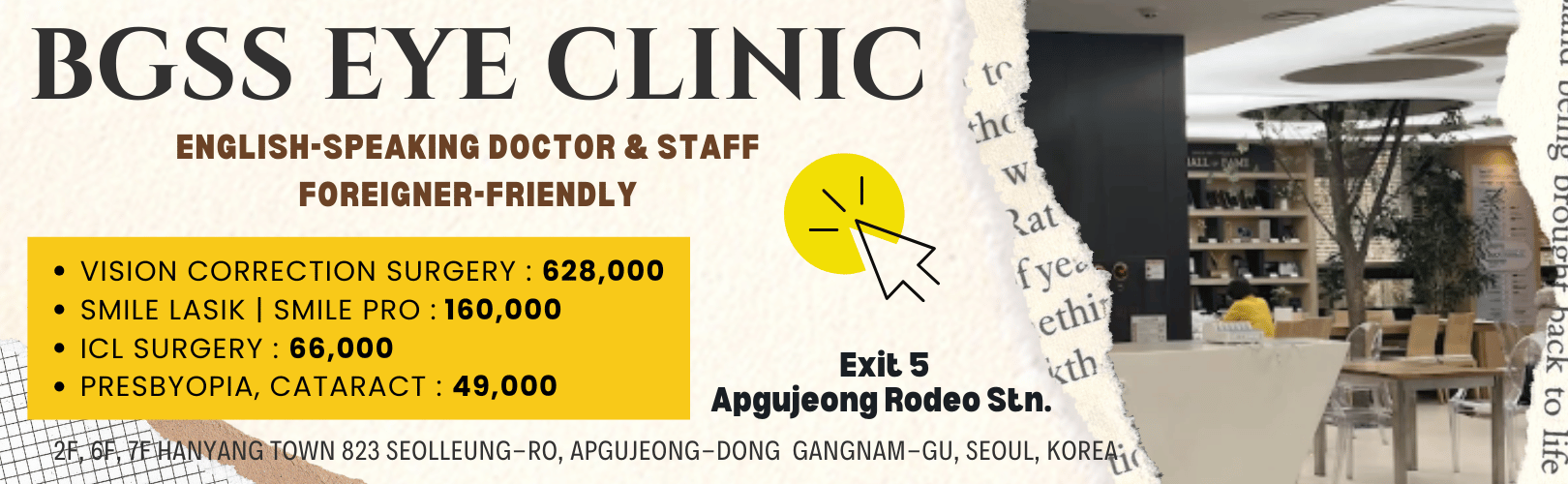
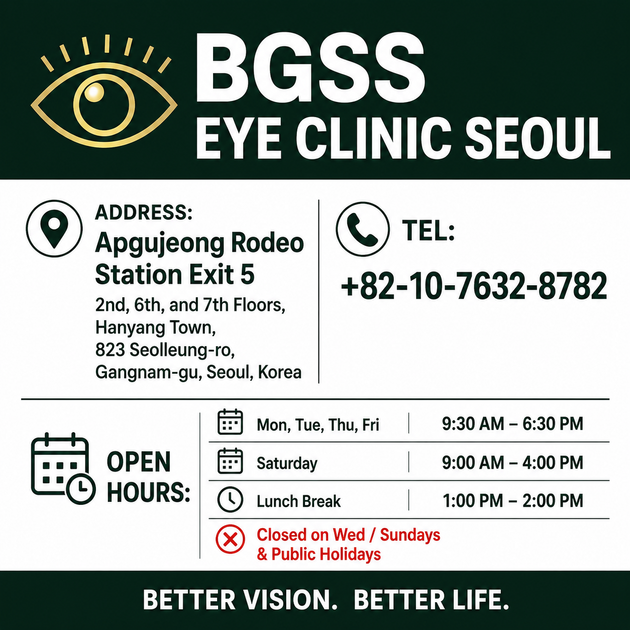
- 2F, 6F, 7F Hanyang Town, 823 Seolleung-ro, Apgujeong-dong, Gangnam-gu, Seoul
- Busan clinic
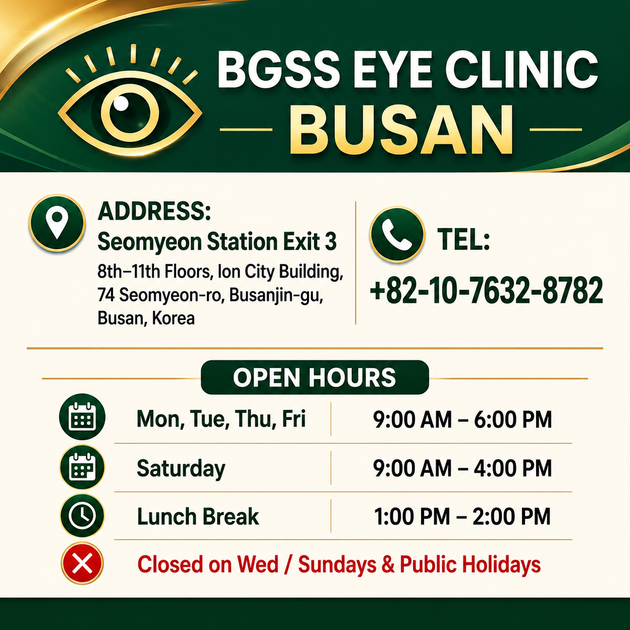
- 8F–11F Ion City Building, 74 Seomyeon-ro, Busanjin-gu, Busan
- Seoul hours
- Mon, Tue, Thu, Fri 9:30–18:30 · Sat 9:00–16:00 · Closed Wed, Sun & holidays